Sunday, April 22, 2018

C++/CLI Interoperability : Using QuantLib in C#

Assume the following scenario : there is QuantLib program available, written in native C++ and you would like to use it from your C# program. What would you do? Now, even there are several extensions available, in this post we will implement specific scheme of using native C++ program in C# via C++/CLI wrapper program. The scheme presented here is widely known as Adapter design pattern.

Our native C++ program is using QuantLib libraries for creating custom implementations for instrument and pricing engine (zero-coupon bond). C++/CLI is then wrapping this native C++ program and exposing only selected methods for its client (C# program). For those completely new to C++/CLI language, there is a relatively comprehensive tutorial available here, written by Adam Sawicki. Needless to say, even this post is presenting relatively simple example of using QuantLib via wrapper, one is able to apply presented scheme to much more complex valuation scenarios. Sounds like a cliche, but "only the sky is the limit" applies well in here.

As far as I see, a programmer is facing complexities here on two fronts : on a pure program level (C++ language, QuantLib library) and on technical level (handling projects and their configurations specifically on Visual Studio). I assume, that the reader is already familiar with C++ language (including its modern features) and has experience on using QuantLib library. Now, in order to decrease the learning curve on that technical level, I decided to include all possible configurations-related steps in here. This means, that when all the steps described in this post have been implemented on a priestly manner, one should end up with succesfully compiled projects. In order to give some concrete back-up for this claim, I have specifically re-created this project succesfully from the scratch now two times.


C++/CLI wrapper project


Create a new C++ CRL Class library project. At this point, pre-installed and pre-built QuantLib and Boost libraries should be available. Create references to required Boost and QuantLib header files and libraries as follows.


In the case one may not have these libraries available, all required procedures for getting this part done correctly is well presented in here and here.

Next, add the following two new header files to this project.

Native C++ header file.

// MJZeroCouponBond.h
#pragma once
#include <ql/quantlib.hpp>
using namespace QuantLib;

namespace QuantLibCppNative {

 // implementation for zero-coupon bond instrument
 class MJZeroCouponBond : public Instrument {
 public:
  // forward class declarations
  class arguments;
  class engine;
  //
  // ctor and implementations for required base class methods
  MJZeroCouponBond(Real faceAmount, Date maturityDate);
  bool isExpired() const;
 private:
  void setupArguments(PricingEngine::arguments* args) const;
  // term sheet related information
  Real faceAmount_;
  Date maturityDate_;
 };

 // inner arguments class
 class MJZeroCouponBond::arguments : public PricingEngine::arguments{
 public:
  void validate() const;
  Real faceAmount;
  Date maturityDate;
 };

 // inner engine class
 class MJZeroCouponBond::engine
  : public GenericEngine < MJZeroCouponBond::arguments, MJZeroCouponBond::results > {
  // base class for all further engine implementations
 };

 // implementation for base class engine
 class MJZeroCouponBondEngine : public MJZeroCouponBond::engine {
 public:
  MJZeroCouponBondEngine(const Handle<YieldTermStructure>& curve);
  void calculate() const;
 private:
  Handle<YieldTermStructure> curve_;
 };

}

C++/CLI header file.

// Wrapper.h
#pragma once
#include "MJZeroCouponBond.h"
using namespace System;

namespace QuantLibCppWrapper {

 // C++/CLI wrapper class for native C++ QuantLib
 public ref class MJZeroCouponBondWrapper {
 public:
  MJZeroCouponBondWrapper(double riskFreeRate_, double faceAmount_, DateTime transactionDate_,
   DateTime maturityDate_, String^ calendar_, String^ daycounter_, int settlementDays_);
  !MJZeroCouponBondWrapper();
  ~MJZeroCouponBondWrapper();
  double PV();
 private:
  // note : class members as native pointers
  QuantLibCppNative::MJZeroCouponBond* bond;
  QuantLibCppNative::MJZeroCouponBondEngine* pricer;
 };
}

Next, add the following two implementation files to this project.

Native C++ implementation file.

// MJZeroCouponBond.cpp
#include "MJZeroCouponBond.h"
using namespace QuantLib;

namespace QuantLibCppNative {

 // implementations for MJZeroCouponBond instrument
 MJZeroCouponBond::MJZeroCouponBond(Real faceAmount, Date maturityDate)
  : faceAmount_(faceAmount), maturityDate_(maturityDate) { // ctor
 }

 bool MJZeroCouponBond::isExpired() const {
  return Settings::instance().evaluationDate() >= maturityDate_;
 }

 void MJZeroCouponBond::setupArguments(PricingEngine::arguments* args) const {
  MJZeroCouponBond::arguments* args_ = dynamic_cast<MJZeroCouponBond::arguments*>(args);
  QL_REQUIRE(args_ != nullptr, "arguments casting error");
  args_->faceAmount = faceAmount_;
  args_->maturityDate = maturityDate_;
 }

 void MJZeroCouponBond::arguments::validate() const {
  QL_REQUIRE(faceAmount > 0.0, "transaction face amount cannot be zero");
 }

 // implementations for MJZeroCouponBondEngine
 MJZeroCouponBondEngine::MJZeroCouponBondEngine(const Handle<YieldTermStructure>& curve)
  : curve_(curve) {
  // register observer (MJZeroCouponBondEngine) with observable (curve)
  registerWith(curve_);
 }

 void MJZeroCouponBondEngine::calculate() const {
  // extract required parameters from arguments or curve object
  // implement the actual pricing algorithm and store result
  Date maturityDate = arguments_.maturityDate;
  Real P = arguments_.faceAmount;
  DiscountFactor df = curve_->discount(maturityDate);
  Real PV = P * df;
  results_.value = PV;
 }

}

C++/CLI implementation file.

// Wrapper.cpp
#pragma once
#include "Wrapper.h"

namespace QuantLibCppWrapper {

 // ctor
 MJZeroCouponBondWrapper::MJZeroCouponBondWrapper(double riskFreeRate_, double faceAmount_, DateTime transactionDate_,
  DateTime maturityDate_, String^ calendar_, String^ daycounter_, int settlementDays_) {

  // conversion for calendar (string to QuantLib::Calendar)
  Calendar calendar;
  if (calendar_->ToUpper() == "TARGET") calendar = TARGET();
   else throw gcnew System::Exception("undefined calendar");
  
  // conversion for daycounter (string to QuantLib::DayCounter)
  DayCounter dayCounter;
  if (daycounter_->ToUpper() == "ACT360") dayCounter = Actual360();
   else throw gcnew System::Exception("undefined daycounter");

  // conversion : transaction and maturity dates (Datetime to QuantLib::Date)
  Date transactionDate(transactionDate_.ToOADate());
  Date maturityDate(maturityDate_.ToOADate());
  Date settlementDate = calendar.advance(transactionDate, Period(settlementDays_, Days));
  Settings::instance().evaluationDate() = settlementDate;

  // create flat discount curve
  auto riskFreeRate = boost::make_shared<SimpleQuote>(riskFreeRate_);
  Handle<Quote> riskFreeRateHandle(riskFreeRate);
  auto riskFreeRateTermStructure = boost::make_shared<FlatForward>(settlementDate, riskFreeRateHandle, dayCounter);
  Handle<YieldTermStructure> riskFreeRateTermStructureHandle(riskFreeRateTermStructure);

  // create instrument and pricer as native pointers
  bond = new QuantLibCppNative::MJZeroCouponBond(faceAmount_, maturityDate);
  pricer = new QuantLibCppNative::MJZeroCouponBondEngine(riskFreeRateTermStructureHandle);

  // pair instrument and pricer
  // note : cast pricer from native pointer to boost shared pointer
  bond->setPricingEngine(static_cast<boost::shared_ptr<QuantLibCppNative::MJZeroCouponBondEngine>>(pricer));
 }

 // finalizer
 MJZeroCouponBondWrapper::!MJZeroCouponBondWrapper() {
  delete bond;
  delete pricer;
 }

 // destructor
 MJZeroCouponBondWrapper::~MJZeroCouponBondWrapper() {
  this->!MJZeroCouponBondWrapper();
 }

 // return pv
 double MJZeroCouponBondWrapper::PV() {
  return bond->NPV();
 }

}

Next, some C++/CLI project settings needs to be modified.

Disable the use of pre-compiled headers.


Update properties to suppress some specific warnings.


Optionally, update properties to suppress (almost) all the other warnings.


After these steps, I have completed a succesfull built for my C++/CLI project.


C# client project


First, create a new C# console project into the existing solution.

Then, add reference to previously created C++/CLI project.


Next, implement the following program to C# project.

using System;

namespace Client {

    static class ZeroCouponBond {
        static void Main() {
            try {

                // create parameters
                double riskFreeRate = 0.01;
                double faceAmount = 1000000.0;
                DateTime transactionDate = new DateTime(2018, 4, 16);
                DateTime maturityDate = new DateTime(2020, 4, 16);
                string calendar = "TARGET";
                string daycounter = "ACT360";
                int settlementDays = 2;
                
                // use C++/CLI wrapper : create bond, request pv
                QuantLibCppWrapper.MJZeroCouponBondWrapper zero = new QuantLibCppWrapper.MJZeroCouponBondWrapper(
                    riskFreeRate, faceAmount, transactionDate, maturityDate, calendar, daycounter, settlementDays);
                double PV = zero.PV();
                Console.WriteLine(PV.ToString());
                GC.SuppressFinalize(zero);
            }
            catch (Exception e) {
                Console.WriteLine(e.Message);
            }
        }
    }
}

Finally, set C# project as start-up project (on Visual Studio, right-click selected C# project and select "Set as StartUp Project").

After completing all previous steps, I have completed a succesfull built for the both projects and got the result of 979953.65 as present value for this 2-year zero-coupon bond, evaluated by using our native C++ QuantLib program via C++/CLI wrapper class.


At this point, we are done.

Postlude : no sweeping under the carpet allowed


Clever eyes might be catching, that there is a SuppressFinalize method call made for Garbage Collector at the end of our C# program. If I will remove that call, I will get the following exception.


Now, the both destructor and finalizer in our C++/CLI project have been correctly implemented, as C++/CLI standard is suggesting. As I understand, the issue is coming from C# program side, as Garbage Collector will do its final memory release sweep before exit. The issue has been pretty completely chewed in here, here and here.

Interesting point is, that in the last given reference above, the author is actually suggesting to delete dynamically allocated member variables (bond and pricer) in destructor. Now, if I will modify that C++/CLI program accordingly as suggested (delete member variables in destructor, not in finalizer, remove trigger call from destructor to finalizer, remove method call for Garbage Collector in C# program), this program will work again as expected. By taking a look at author's past experience, at least I would come to the conclusion, that this suggested approach is also a way to go.

Finally, thanks a lot again for using your precious time for reading this blog. I hope you got what you were looking for.
-Mike
Thursday, March 1, 2018

PowerShell : scenario generator

There are always some game-changing moments in life. Earlier this year, I finally discovered the greatness of PowerShell. Love at first sight. As a decent "honeymoon project", I re-implemented one of my C# programs to PowerShell. This post is opening this particular program, which takes base market data as input and creates stress market scenarios (for a third-party analytics software), based on given XML configuration files.

It should be noted, that this particular program uses CSV file input for constructing base market data. However, since PowerShell does enjoy the benefits of accessing .NET framework classes, one may request source data directly from database - if so desired.

Program configurations


The following screenshot shows general configurations for this program. SourceFilePath attribute captures the source market data CSV file and TargetFolderPath captures the folder, into which all market scenario files will be created. Finally, ScenarioConfigurationsPath captures the folder, which contains all XML scenario configuration files. This configuration XML file should be stored in a chosen directory.

<Configurations>
    <!-- attributes for scenario generator settings -->
    <ScenarioConfigurationsPath>\\Temp\ScenarioConfigurations\</ScenarioConfigurationsPath>
    <SourceFilePath>\\Temp\baseMarket.csv</SourceFilePath>
    <TargetFolderPath>\\Temp\Scenarios\</TargetFolderPath>
</Configurations>

Market data


The following screenshot shows base market data. Due to brevity reasons, only USD swap curve has been used here as an example. All risk factors (market data points) are effectively given as key-value pairs (ticker, value). As an example, USD.IBOR.SWAP.3M.10Y.MID is a 10-year mid-market quote for USD-nominated swap, where floating rate index (USD Libor) is fixed and paid on a quarterly basis.

It should be noted, that the system for risk factor tickers construction should always lead to a scheme, in which every risk factor will have one and only one unique ticker. This will then guarantee, that we can drill down and stress individual risk factor with regex expressions, if so desired. This data should be copied to CSV file (directory has been defined in previous configuration file).

"USD.IBOR.CASH.3M.1BD.MID,0.01445"
"USD.IBOR.CASH.3M.1W.MID,0.0147313"
"USD.IBOR.CASH.3M.1M.MID,0.0159563"
"USD.IBOR.CASH.3M.2M.MID,0.0173311"
"USD.IBOR.CASH.3M.3M.MID,0.0189213"
"USD.IBOR.FRA.3M.3M.6M.MID,0.02283"
"USD.IBOR.FRA.3M.6M.9M.MID,0.02363"
"USD.IBOR.FRA.3M.9M.12M.MID,0.02503"
"USD.IBOR.SWAP.3M.2Y.MID,0.025387"
"USD.IBOR.SWAP.3M.3Y.MID,0.026844"
"USD.IBOR.SWAP.3M.4Y.MID,0.027649"
"USD.IBOR.SWAP.3M.5Y.MID,0.028163"
"USD.IBOR.SWAP.3M.6Y.MID,0.028579"
"USD.IBOR.SWAP.3M.7Y.MID,0.028935"
"USD.IBOR.SWAP.3M.8Y.MID,0.029236"
"USD.IBOR.SWAP.3M.9Y.MID,0.029516"
"USD.IBOR.SWAP.3M.10Y.MID,0.029758"
"USD.IBOR.SWAP.3M.11Y.MID,0.030049"
"USD.IBOR.SWAP.3M.12Y.MID,0.030192"
"USD.IBOR.SWAP.3M.15Y.MID,0.030526"
"USD.IBOR.SWAP.3M.20Y.MID,0.030775"

Risk factor class


A simple C# class is used to host one risk factor (ticker, value). It should be noted at this point, that this particular custom C# class will be used within our PowerShell script.

using System;
public class RiskFactor {
    public string key;
    public double value;
    // instance constructor
    public RiskFactor(string stream) {
        this.key = stream.Split(',')[0];
        this.value = Convert.ToDouble(stream.Split(',')[1]);
    }
    // deep copy constructor
    public RiskFactor(RiskFactor riskFactor) {
        key = riskFactor.key;
        value = riskFactor.value;
    }
    // object to string
    public override string ToString() {
        return String.Concat(key, ',', Convert.ToString(value));
    }
}

Scenario configurations


The following screenshot shows XML configurations for one market scenario. One such scenario can have several different scenario items (Say, stress these rates up, stress those rates down, apply these changes to all FX rates against EUR and set hard-coded values for all CDS curves). From these configurations, ID and description are self-explainable. Attribute regExpression captures all regex expressions (scenario items), which will be searched from risk factor tickers. As soon as regex match is found, the program will use corresponding operationType attribute to identify desired stress operation (addition, multiplication or hard-coded value). Finally, the amount of change which will be applied in risk factor value is defined within stressValue attribute. This XML configuration should be stored (directory has been defined in program configuration file).

<!-- operation types : 0 = ADDITION, 1 = MULTIPLICATION, 2 = HARD-CODED VALUE -->
<Scenario>
  <ID>CURVE.STRESS.CUSTOM.1</ID>
  <description>custom stress scenario for USD swap curve</description>
  <regExpression>^USD\.*.*CASH,^USD\.*.*FRA,^USD\.*.*SWAP</regExpression>
  <operationType>1,0,2</operationType>
  <stressValue>1.25,0.015,0.05</stressValue>
</Scenario>

Finally, the following screenshot shows resulting market data, when all configured scenario items have been applied. This is the content of output CSV file, created by PowerShell program.

"USD.IBOR.CASH.3M.1BD.MID,0.0180625"
"USD.IBOR.CASH.3M.1W.MID,0.018414125"
"USD.IBOR.CASH.3M.1M.MID,0.019945375"
"USD.IBOR.CASH.3M.2M.MID,0.021663875"
"USD.IBOR.CASH.3M.3M.MID,0.023651625"
"USD.IBOR.FRA.3M.3M.6M.MID,0.03783"
"USD.IBOR.FRA.3M.6M.9M.MID,0.03863"
"USD.IBOR.FRA.3M.9M.12M.MID,0.04003"
"USD.IBOR.SWAP.3M.2Y.MID,0.05"
"USD.IBOR.SWAP.3M.3Y.MID,0.05"
"USD.IBOR.SWAP.3M.4Y.MID,0.05"
"USD.IBOR.SWAP.3M.5Y.MID,0.05"
"USD.IBOR.SWAP.3M.6Y.MID,0.05"
"USD.IBOR.SWAP.3M.7Y.MID,0.05"
"USD.IBOR.SWAP.3M.8Y.MID,0.05"
"USD.IBOR.SWAP.3M.9Y.MID,0.05"
"USD.IBOR.SWAP.3M.10Y.MID,0.05"
"USD.IBOR.SWAP.3M.11Y.MID,0.05"
"USD.IBOR.SWAP.3M.12Y.MID,0.05"
"USD.IBOR.SWAP.3M.15Y.MID,0.05"
"USD.IBOR.SWAP.3M.20Y.MID,0.05"

Program


# risk factor class
Add-Type @"
using System;
public class RiskFactor {
    public string key;
    public double value;
    // instance constructor
    public RiskFactor(string stream) {
        this.key = stream.Split(',')[0];
        this.value = Convert.ToDouble(stream.Split(',')[1]);
    }
    // deep copy constructor
    public RiskFactor(RiskFactor riskFactor) {
        key = riskFactor.key;
        value = riskFactor.value;
    }
    // object to string
    public override string ToString() {
        return String.Concat(key, ',', Convert.ToString(value));
    }
}
"@


function ProcessScenario([System.Xml.XmlDocument]$scenario, [System.Collections.Generic.List[RiskFactor]]$riskFactors) {
    
    # extract scenario items
    $regExpressions = $scenario.SelectSingleNode("Scenario/regExpression").InnerText.Split(',')
    $operationTypes = $scenario.SelectSingleNode("Scenario/operationType").InnerText.Split(',')
    $stressValues = $scenario.SelectSingleNode("Scenario/stressValue").InnerText.Split(',')
    
    # loop through all scenario regex expression items
    for($i = 0; $i -lt $regExpressions.Count; $i++) {
        # loop through all risk factors
        $riskFactors | ForEach-Object { 
            $match = $_.key -match $regExpressions[$i]
            # conditionally, apply regex expression to risk factor value
            if($match -eq $true) {
                $stressedValue = $_.value
                switch($operationTypes[$i]) {
                    # addition
                    0 { $stressedValue += [double]$stressValues[$i] }
                    # multiplication
                    1 { $stressedValue *= [double]$stressValues[$i] }
                    # hard-coded value
                    2 { $stressedValue = [double]$stressValues[$i] }
                }
                $_.value = $stressedValue
            }
        }
    }
}


function Main() {

    # create program configurations from xml file
    $configurationFilePath = "\\Temp\Configurations.xml"
    $configurations = New-Object System.Xml.XmlDocument
    $configurations.Load($configurationFilePath)

    # extract risk factor objects to master list
    $riskFactors = New-Object System.Collections.Generic.List[RiskFactor]
    Import-Csv -Path $configurations.SelectSingleNode("Configurations/SourceFilePath").InnerText -Header stream | 
        ForEach-Object { $riskFactors.Add((New-Object RiskFactor($_.stream))) }

    # extract all scenario xml configurations to list
    $scenarios = New-Object System.Collections.Generic.List[System.Xml.XmlDocument]
    Get-ChildItem -Path $configurations.SelectSingleNode("Configurations/ScenarioConfigurationsPath").InnerText | 
        ForEach-Object { 
            $scenario = New-Object System.Xml.XmlDocument
            $scenario.Load($_.FullName)
            $scenarios.Add($scenario) 
        }

    # loop through all scenarios xml configurations
    $scenarios | ForEach-Object { 
        # create risk factor list deep copy
        $riskFactorsDeepCopy = New-Object System.Collections.Generic.List[RiskFactor]
        $riskFactors | ForEach-Object { 
            $riskFactorsDeepCopy.Add((New-Object RiskFactor($_))) 
        }
        # apply scenario changes to copied risk factor values
        ProcessScenario $_ $riskFactorsDeepCopy

        # create output directory and remove existing file if exists
        $scenarioFileName = [System.String]::Concat($_.SelectSingleNode("Scenario/ID").InnerText, ".csv")
        $targetFolderPath = $configurations.SelectSingleNode("Configurations/TargetFolderPath").InnerText
        $scenarioFilePathName = [System.IO.Path]::Combine($targetFolderPath, $scenarioFileName)
        Remove-Item -Path $scenarioFilePathName -ErrorAction SilentlyContinue
        
        # create csv output file for processed risk factors
        $riskFactorsDeepCopy | ForEach-Object { New-Object psobject -Property @{string = $_.ToString() } } |
            ConvertTo-Csv -NoTypeInformation | select -Skip 1 | Out-File $scenarioFilePathName
    }
}


# required tag
. Main

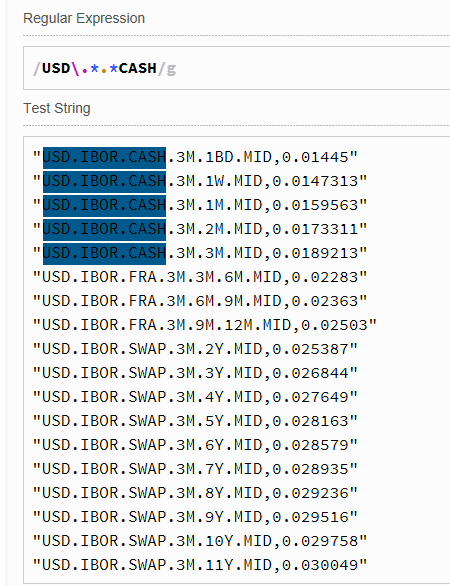
Handy way to create and test regex expressions is to use any online tool available. As an example, the first scenario item (^USD\.*.*CASH) has been applied to a given base market data. The last screenshot below shows all regex matches.

Thanks again for reading this blog.
-Mike


Tuesday, February 6, 2018

Excel : implementing multithreading using C# and Excel-DNA

Multithreading possibilities for VBA has been chewed in this post. My conclusion back then was, that there is no multi-threading possibilities for VBA. One reader has then been commenting this as follows :

"Correct to say there is no multithreading in VBA however, you can very easily create your multithreading functionality in a c# dll and expose the interface via Interops for VBA to consume. Then all you need to do is to pass in the data into the function and walla, you have multithreading. Interops is a very powerful feature and VBA fully supports it."

For the sake of completeness, I will present one possible program to implement such multithreading scheme for Excel, by using Parallel class for the actual multi-threading part and Excel-DNA for interfacing the program back to Excel (using Excel only as Input-Output platform). Excel interfacing part used in this post, has already been completely chewed within this post. Note, that by using instructions given in here or here, one can relatively easy interface this multithreading program back to VBA, instead of Excel.

The program


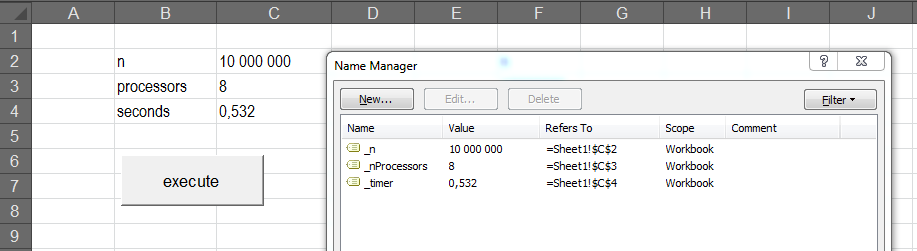
This unsurprising program is simply processing a task (simulate N amount of normally distributed random numbers) shared for M processors. Amount of simulated numbers and number of processors used is decided by the client (Excel). Finally, the program will print the aggregated time consumed for this task back to Excel. Needless to say, the effect of multithreading can be demonstrated by changing the number of processors in Excel worksheet.


Copy-Paste the following program presented below into a new C# project. Also, follow carefully all instructions given in this post.

Thanks for reading this blog.
-Mike

// ExcelInterface.cs
using System;
using System.Collections.Generic;
using System.Diagnostics;
using System.Threading.Tasks;
using System.Windows.Forms;
using ExcelDna.Integration;

namespace ExcelInterface {
    // type definition, delegate for exporting data from processor to queue
    using Processor = Action<int, DataMessenger>;
    public delegate void DataMessenger(List<double> result);

    public static class ExcelInterface {
        // method available in excel
        public static void execute() {
            try {
                // create Excel application object
                dynamic Excel = ExcelDnaUtil.Application;
                //
                // get parameters from worksheet named ranges
                int n = (int)Excel.Range["_n"].Value2;
                int nProcessors = (int)Excel.Range["_nProcessors"].Value2;
                int nPerProcessor = n / nProcessors;
                // create data thread-safe queue and random processors
                RandomQueue messageQueue = new RandomQueue();
                List<Processor> processors = new List<Processor>();
                for (int i = 0; i < nProcessors; ++i) {
                    processors.Add(Factory.CreateProcessor());
                }
                // host timer, execute all processors in parallel
                Stopwatch timer = new Stopwatch();
                timer.Start();
                Parallel.For(0, nProcessors, i => {
                    processors[i].Invoke(nPerProcessor, messageQueue.Enqueue); 
                });
                timer.Stop();
                //
                // print processing time to excel
                double timeElapsed = timer.Elapsed.TotalSeconds;
                Excel.Range["_timer"] = timeElapsed;
            }
            catch (Exception e) {
                MessageBox.Show(e.Message);
            }
        }
    }
}

// RandomQueue.cs
using System;
using System.Collections.Concurrent;
using System.Collections.Generic;

namespace ExcelInterface {
    // wrapper class for ConcurrentQueue data structure
    public class RandomQueue {
        private ConcurrentQueue<List<double>> randomQueue;
        public RandomQueue() {
            randomQueue = new ConcurrentQueue<List<double>>();
        }
        // add
        public void Enqueue(List<double> data) {
            randomQueue.Enqueue(data);
        }
        // remove
        public List<double> Dequeue() {
            List<double> data = null;
            bool hasValue = false;
            while (!hasValue) hasValue = randomQueue.TryDequeue(out data);
            return data;
        }
    }
}
// Factory.cs
using System;
using System.Collections.Generic;

namespace ExcelInterface {
    // type definition
    using Processor = Action<int, DataMessenger>;
    
    public static class Factory {
        // factory method for creating processor for random generator
        public static Processor CreateProcessor() {
            //
            // create standard normal variable generator
            // using action delegate and lambda expression
            Processor process =
            (int n, DataMessenger dataMessenger) => {
                Random generator = new Random(Guid.NewGuid().GetHashCode());
                List<double> normalRandomList = new List<double>();
                // loop through n
                for (int i = 0; i < n; ++i) {
                    double uniformRandomSum = 0.0;
                    // create standard normal random variable using CLT
                    for (int j = 0; j < 12; ++j) {
                        double uniformRandom = 0.0;
                        while (true) {
                            uniformRandom = generator.NextDouble();
                            if (uniformRandom > 0.0) break;
                        }
                        uniformRandomSum += uniformRandom;
                    }
                    normalRandomList.Add(uniformRandomSum - 6.0);
                }
                // send list of normal random variables to queue
                dataMessenger(normalRandomList);
            };
            return process;
        }
    }
}

Friday, December 29, 2017

QuantLib : implementing Equity-linked note using Monte Carlo framework

Within the last post, an implementation for a simple custom instrument and analytical pricing engine was presented. This post is presenting a bit more complex implementation for an equity-linked note, using custom pricing engine implementation built on the top of QuantLib Monte Carlo framework.


Term sheet


The most essential transaction details have been presented within the following screenshot below.


In a nutshell, 3-year holding period has been divided into three annual periods. For each period, running cumulative (but capped) coupon will be calculated based on simulated index fixing values (Geometric Brownian Motion). At the end of each period, period payoff (floored) will be calculated. Pricing-wise, this period payoff will then be discounted to present valuation date. Structure total PV is the sum of all discounted period payoffs.

In order to get more familiar with QuantLib Monte Carlo framework, one may take a look at Implementing QuantLib blog or get the actual book on QuantLib implementation from Leanpub. Also, MoneyScience is organizing Introduction to QuantLib Development course regularly. The most essential parts of the library are thoroughly covered during this 3-day training course, hosted by QuantLib lead developer Luigi Ballabio. Thanks for reading this blog. Merry Christmas and Happy New Year for everybody.

-Mike


// EquityLinkedNote.h
#pragma once
#include <ql/quantlib.hpp>
using namespace QuantLib;
//
// instrument implementation for equity-linked note
class EquityLinkedNote : public Instrument {
public:
 // forward class declarations
 class arguments;
 class engine;
 //
 // ctor and implementations for required base class methods
 EquityLinkedNote(Real notional, Real initialFixing, const std::vector<Date>& fixingDates, 
  const std::vector<Date>& paymentDates, Real cap, Real floor);
 bool isExpired() const;
private:
 void setupArguments(PricingEngine::arguments* args) const;
 // term sheet information
 Real notional_;
 Real initialFixing_;
 std::vector<Date> fixingDates_;
 std::vector<Date> paymentDates_;
 Real cap_;
 Real floor_;
};
// inner arguments class
class EquityLinkedNote::arguments : public PricingEngine::arguments{
public:
 void validate() const;
 Real notional;
 Real initialFixing;
 std::vector<Date> fixingDates;
 std::vector<Date> paymentDates;
 Real cap;
 Real floor;
};
// inner engine class
class EquityLinkedNote::engine
 : public GenericEngine<EquityLinkedNote::arguments, EquityLinkedNote::results> {
 // base class for all further engine implementations
};
//
//
// path pricer implementation for equity-linked note
class EquityLinkedNotePathPricer : public PathPricer<Path> {
public:
 EquityLinkedNotePathPricer(Real notional, Real initialFixing, const std::vector<Date>& fixingDates,
  const std::vector<Date>& paymentDates, Real cap, Real floor, const Handle<YieldTermStructure>& curve);
 Real operator()(const Path& path) const;
private:
 Real notional_;
 Real initialFixing_;
 std::vector<Date> fixingDates_;
 std::vector<Date> paymentDates_;
 Real cap_;
 Real floor_;
 Handle<YieldTermStructure> curve_;
};
//
//
// monte carlo framework engine implementation for base engine class
template <typename RNG = PseudoRandom, typename S = Statistics>
class EquityLinkedNoteMonteCarloPricer : public EquityLinkedNote::engine, private McSimulation<SingleVariate, RNG, S> {
public:
 // ctor
 EquityLinkedNoteMonteCarloPricer(const boost::shared_ptr<StochasticProcess>& process,
  const Handle<YieldTermStructure>& curve, bool antitheticVariate, Size requiredSamples,
  Real requiredTolerance, Size maxSamples, BigNatural seed)
  : McSimulation<SingleVariate, RNG, S>(antitheticVariate, false), process_(process), curve_(curve),
  requiredSamples_(requiredSamples), requiredTolerance_(requiredTolerance), maxSamples_(maxSamples), seed_(seed) {
   // register observer (pricer) with observables (stochastic process, curve)
   registerWith(process_);
   registerWith(curve_);
  }
 // implementation for required base engine class method
 void calculate() const {
  // the actual simulation process will be performed within the following method
  McSimulation<SingleVariate, RNG, S>::calculate(requiredTolerance_, requiredSamples_, maxSamples_);
  this->results_.value = this->mcModel_->sampleAccumulator().mean();
  //
  if (RNG::allowsErrorEstimate) {
   this->results_.errorEstimate = this->mcModel_->sampleAccumulator().errorEstimate();
  }
  else {
   this->results_.errorEstimate = Null<Real>();
  }
 }
private:
 // type definitions
 typedef McSimulation<SingleVariate, RNG, S> simulation;
 typedef typename simulation::path_pricer_type path_pricer_type;
 typedef typename simulation::path_generator_type path_generator_type;
 //
 // implementation for McSimulation class virtual method
 TimeGrid timeGrid() const {
  // create time grid based on a set of given index fixing dates
  Date referenceDate = curve_->referenceDate();
  DayCounter dayCounter = curve_->dayCounter();
  std::vector<Time> fixingTimes(arguments_.fixingDates.size());
  for (Size i = 0; i != fixingTimes.size(); ++i) {
   fixingTimes[i] = dayCounter.yearFraction(referenceDate, arguments_.fixingDates[i]);
  }
  return TimeGrid(fixingTimes.begin(), fixingTimes.end());
 }
 // implementation for McSimulation class virtual method
 boost::shared_ptr<path_generator_type> pathGenerator() const {
  // create time grid and get information concerning number of simulation steps for a path
  TimeGrid grid = timeGrid();
  Size steps = (grid.size() - 1);
  // create random sequence generator and return path generator
  typename RNG::rsg_type generator = RNG::make_sequence_generator(steps, seed_);
  return boost::make_shared<path_generator_type>(process_, grid, generator, false);
 }
 // implementation for McSimulation class virtual method
 boost::shared_ptr<path_pricer_type> pathPricer() const {
  // create path pricer implementation for equity-linked note
  return boost::make_shared<EquityLinkedNotePathPricer>(arguments_.notional, arguments_.initialFixing, 
   arguments_.fixingDates, arguments_.paymentDates, arguments_.cap, arguments_.floor, this->curve_);
 }
 // private data members
 boost::shared_ptr<StochasticProcess> process_;
 Handle<YieldTermStructure> curve_;
 Size requiredSamples_;
 Real requiredTolerance_;
 Size maxSamples_;
 BigNatural seed_;
};
//
//
//
//
//
// EquityLinkedNote.cpp
#include "EquityLinkedNote.h"
#include <algorithm>
//
// implementations for equity-linked note methods
EquityLinkedNote::EquityLinkedNote(Real notional, Real initialFixing, const std::vector<Date>& fixingDates,
 const std::vector<Date>& paymentDates, Real cap, Real floor)
 : notional_(notional), initialFixing_(initialFixing), fixingDates_(fixingDates), 
 paymentDates_(paymentDates), cap_(cap), floor_(floor) {
 // ctor
}
bool EquityLinkedNote::isExpired() const {
 Date valuationDate = Settings::instance().evaluationDate();
 // note is expired, if valuation date is greater than the last fixing date
 if (valuationDate > fixingDates_.back())
  return true;
 return false;
}
void EquityLinkedNote::setupArguments(PricingEngine::arguments* args) const {
 EquityLinkedNote::arguments* args_ = dynamic_cast<EquityLinkedNote::arguments*>(args);
 QL_REQUIRE(args_ != nullptr, "arguments casting error");
 args_->notional = notional_;
 args_->initialFixing = initialFixing_;
 args_->fixingDates = fixingDates_;
 args_->paymentDates = paymentDates_;
 args_->cap = cap_;
 args_->floor = floor_;
}
void EquityLinkedNote::arguments::validate() const {
 // checks for some general argument properties
 QL_REQUIRE(notional > 0.0, "notional must be greater than zero");
 QL_REQUIRE(initialFixing > 0.0, "initial fixing must be greater than zero");
 QL_REQUIRE(cap > floor, "cap must be greater than floor");
 // check for date consistency : all payment dates have to be included 
 // within a set of given fixing dates
 for (int i = 0; i != paymentDates.size(); ++i) {
  if (std::find(fixingDates.begin(), fixingDates.end(), paymentDates[i]) == fixingDates.end()) {
   QL_REQUIRE(false, "payment date has to be included within given fixing dates");
  }
 }
}
//
// implementations for equity-linked path pricer methods
EquityLinkedNotePathPricer::EquityLinkedNotePathPricer(Real notional, Real initialFixing, const std::vector<Date>& fixingDates,
 const std::vector<Date>& paymentDates, Real cap, Real floor, const Handle<YieldTermStructure>& curve)
 : notional_(notional), initialFixing_(initialFixing), fixingDates_(fixingDates),
 paymentDates_(paymentDates), cap_(cap), floor_(floor), curve_(curve) {
 // ctor
}
// the actual pricing algorithm for a simulated path is implemented in this method
Real EquityLinkedNotePathPricer::operator()(const Path& path) const {
 Real coupon = 0.0;
 Real cumulativeCoupon = 0.0;
 Real aggregatePathPayoff = 0.0;
 int paymentDateCounter = 0;
 //
 // loop through fixing dates
 for (int i = 1; i != fixingDates_.size(); ++i) {
  // calculate floating coupon, based on simulated index fixing values
  coupon = std::min(path.at(i) / path.at(i - 1) - 1, cap_);
  // add floating coupon to cumulative coupon
  cumulativeCoupon += coupon;
  //
  // calculate period payoff for each payment date
  if (fixingDates_[i] == paymentDates_[paymentDateCounter]) {
   // calculate discounted payoff for current period, add value to aggregate path payoff
   aggregatePathPayoff += std::max(cumulativeCoupon, floor_) * notional_ * curve_->discount(fixingDates_[i]);
   // re-initialize cumulative coupon to zero, look for the next payment date
   cumulativeCoupon = 0.0;
   paymentDateCounter++;
  }
 }
 return aggregatePathPayoff;
}
//
//
//
//
//
// main.cpp
#include "EquityLinkedNote.h"
//
int main() {
 try {
  // common data : calendar, daycounter, dates
  Calendar calendar = TARGET();
  DayCounter dayCounter = Actual360();
  Date transactionDate(30, October, 2017);
  Natural settlementDays = 2;
  Date settlementDate = calendar.advance(transactionDate, Period(settlementDays, Days));
  Settings::instance().evaluationDate() = settlementDate;
  //
  // term sheet parameters
  Real notional = 1000000.0;
  Real initialFixing = 3662.18;
  Real cap = 0.015;
  Real floor = 0.0;
  std::vector<Date> fixingDates {
   Date(30, November, 2017), Date(30, December, 2017), Date(30, January, 2018), 
   Date(28, February, 2018), Date(30, March, 2018), Date(30, April, 2018),
   Date(30, May, 2018), Date(30, June, 2018), Date(30, July, 2018), 
   Date(30, August, 2018), Date(30, September, 2018), Date(30, October, 2018),
   Date(30, November, 2018), Date(30, December, 2018), Date(30, January, 2019), 
   Date(28, February, 2019), Date(30, March, 2019), Date(30, April, 2019),
   Date(30, May, 2019), Date(30, June, 2019), Date(30, July, 2019), 
   Date(30, August, 2019), Date(30, September, 2019), Date(30, October, 2019),
   Date(30, November, 2019), Date(30, December, 2019), Date(30, January, 2020), 
   Date(29, February, 2020), Date(30, March, 2020), Date(30, April, 2020),
   Date(30, May, 2020), Date(30, June, 2020), Date(30, July, 2020), 
   Date(30, August, 2020), Date(30, September, 2020), Date(30, October, 2020)
  };
  std::vector<Date> paymentDates {
   Date(30, October, 2018), Date(30, October, 2019), Date(30, October, 2020)
  };
  //
  // create structured equity-linked note
  auto note = boost::make_shared<EquityLinkedNote>(notional, initialFixing, fixingDates, paymentDates, cap, floor);
  //
  // market data
  // create discount curve
  Real riskFreeRate = 0.01;
  auto riskFreeRateQuote = boost::make_shared<SimpleQuote>(riskFreeRate);
  Handle<Quote> riskFreeRateHandle(riskFreeRateQuote);
  auto riskFreeRateTermStructure = boost::make_shared<FlatForward>(settlementDate, riskFreeRateHandle, dayCounter);
  Handle<YieldTermStructure> riskFreeRateTermStructureHandle(riskFreeRateTermStructure);
  //
  // create stochastic process
  Handle<Quote> initialFixingHandle(boost::shared_ptr<Quote>(new SimpleQuote(initialFixing)));
  Real volatility = 0.16;
  auto volatilityQuote = boost::make_shared<SimpleQuote>(volatility);
  Handle<Quote> volatilityHandle(volatilityQuote);
  Handle<BlackVolTermStructure> volatilityTermStructureHandle(boost::shared_ptr<BlackVolTermStructure>
   (new BlackConstantVol(settlementDays, calendar, volatilityHandle, dayCounter)));
  auto process = boost::make_shared<BlackScholesProcess>(initialFixingHandle, riskFreeRateTermStructureHandle, volatilityTermStructureHandle);
  //
  // create simulation-related attributes
  bool useAntitheticVariates = false;
  Size requiredSamples = 1000;
  Real requiredTolerance = Null<Real>();
  Size maxSamples = 1000;
  BigNatural seed = 0;
  //
  auto engine = boost::make_shared<EquityLinkedNoteMonteCarloPricer<PseudoRandom, Statistics>>
   (process, riskFreeRateTermStructureHandle, useAntitheticVariates, requiredSamples, requiredTolerance, maxSamples, seed);
  note->setPricingEngine(engine);
  std::cout << note->NPV() << std::endl;
 }
 catch (std::exception& e) {
  std::cout << e.what() << std::endl;
 }
 return 0;
}


Excel


The following screenshots are presenting parameters, result, path simulations and coupon calculations in Excel for this structured note. PV is an average of all discounted path payoffs.


QuantLib : custom instrument and pricing engine implementation

Using in-built QuantLib instruments and pricing engines is almost trivial, since the library is actually performing all required groundwork on behalf of a lucky user. Hair may start to get gray, as soon as one wants to implement a new instrument and related pricing engine. The example presented below is implementing a simple zero-coupon bond instrument and corresponding (analytical) pricing engine.

// MJZeroCouponBond.h
#pragma once
#include <ql/quantlib.hpp>
using namespace QuantLib;
//
// implementation for zero-coupon bond instrument
class MJZeroCouponBond : public Instrument {
public:
 // forward class declarations
 class arguments;
 class engine;
 //
 // ctor and implementations for required base class methods
 MJZeroCouponBond(Real faceAmount, Date maturityDate);
 bool isExpired() const;
private:
 void setupArguments(PricingEngine::arguments* args) const;
 // term sheet related information
 Real faceAmount_;
 Date maturityDate_;
};
// inner arguments class
class MJZeroCouponBond::arguments : public PricingEngine::arguments {
public:
 void validate() const;
 Real faceAmount;
 Date maturityDate;
};
// inner engine class
class MJZeroCouponBond::engine 
 : public GenericEngine<MJZeroCouponBond::arguments, MJZeroCouponBond::results> {
 // base class for all further engine implementations
};
//
// implementation for base class engine
class MJZeroCouponBondEngine : public MJZeroCouponBond::engine {
public:
 MJZeroCouponBondEngine(const Handle<YieldTermStructure>& curve);
 void calculate() const;
private:
 Handle<YieldTermStructure> curve_;
};
//
//
//
//
//
// MJZeroCouponBond.cpp
#include "MJZeroCouponBond.h"
using namespace QuantLib;
//
// implementations for MJZeroCouponBond instrument
MJZeroCouponBond::MJZeroCouponBond(Real faceAmount, Date maturityDate) 
 : faceAmount_(faceAmount), maturityDate_(maturityDate) {
 // ctor
}
bool MJZeroCouponBond::isExpired() const {
 return Settings::instance().evaluationDate() >= maturityDate_;
}
void MJZeroCouponBond::setupArguments(PricingEngine::arguments* args) const {
 MJZeroCouponBond::arguments* args_ = dynamic_cast<MJZeroCouponBond::arguments*>(args);
 QL_REQUIRE(args_ != nullptr, "arguments casting error");
 args_->faceAmount = faceAmount_;
 args_->maturityDate = maturityDate_;
}
void MJZeroCouponBond::arguments::validate() const {
 QL_REQUIRE(faceAmount > 0.0, "transaction face amount cannot be zero");
}
//
// implementations for MJZeroCouponBondEngine
MJZeroCouponBondEngine::MJZeroCouponBondEngine(const Handle<YieldTermStructure>& curve)
 : curve_(curve) {
 // register observer (MJZeroCouponBondEngine) with observable (curve)
 registerWith(curve_);
}
void MJZeroCouponBondEngine::calculate() const {
 // extract required parameters from arguments or curve object
 // implement the actual pricing algorithm and store result
 Date maturityDate = arguments_.maturityDate;
 Real P = arguments_.faceAmount;
 DiscountFactor df = curve_->discount(maturityDate);
 Real PV = P * df;
 results_.value = PV;
}
//
//
//
//
//
// Tester.cpp
#pragma once
#include "MJZeroCouponBond.h"
using namespace QuantLib;
//
int main() {
 //
 try {
  // common data : calendar, daycounter, dates
  Calendar calendar = TARGET();
  DayCounter dayCounter = Actual360();
  Date transactionDate(18, December, 2017);
  Date maturityDate(18, December, 2030);
  Natural settlementDays = 2;
  Date settlementDate = calendar.advance(transactionDate, Period(settlementDays, Days));
  Settings::instance().evaluationDate() = settlementDate;
  //
  // create flat discount curve
  auto riskFreeRate = boost::make_shared<SimpleQuote>(0.01);
  Handle<Quote> riskFreeRateHandle(riskFreeRate);
  auto riskFreeRateTermStructure = boost::make_shared<FlatForward>(settlementDate, riskFreeRateHandle, dayCounter);
  Handle<YieldTermStructure> riskFreeRateTermStructureHandle(riskFreeRateTermStructure);
  //
  // create zero coupon bonds (QL in-built and custom implementation)
  Real faceAmount = 250000.0;
  auto QLZero = boost::make_shared<ZeroCouponBond>(settlementDays, calendar, faceAmount, maturityDate);
  auto MJZero = boost::make_shared<MJZeroCouponBond>(faceAmount, maturityDate);
  //
  // create pricing engines  (QL in-built and custom implementation)
  auto QLEngine = boost::make_shared<DiscountingBondEngine>(riskFreeRateTermStructureHandle);
  auto MJEngine = boost::make_shared<MJZeroCouponBondEngine>(riskFreeRateTermStructureHandle);
  //
  // set engines to instruments and price the both transaction
  QLZero->setPricingEngine(QLEngine);
  MJZero->setPricingEngine(MJEngine);
  //
  std::cout << "pre-shift QL zero " << QLZero->NPV() << std::endl;
  std::cout << "pre-shift MJ zero " << MJZero->NPV() << std::endl;
  //
  // shift valuation curve and re-price the both transactions
  riskFreeRate->setValue(0.0101);
  std::cout << "post-shift QL zero " << QLZero->NPV() << std::endl;
  std::cout << "post-shift MJ zero " << MJZero->NPV() << std::endl;
 }
 catch (std::exception& e) {
  std::cout << e.what() << std::endl;
 }
 return 0;
}


In order to get more familiar with QuantLib Monte Carlo framework, one may take a look at Implementing QuantLib blog or get the actual book on QuantLib implementation from Leanpub. Also, MoneyScience is organizing Introduction to QuantLib Development course regularly. The most essential parts of the library are thoroughly covered during this 3-day training course, hosted by QuantLib lead developer Luigi Ballabio. Thanks for reading this blog. Merry Christmas and Happy New Year for everybody.
-Mike


Wednesday, September 6, 2017

QuantLib : Hull-White one-factor model calibration

Sometimes during the last year I published one post on simulating Hull-White interest rate paths using Quantlib. My conclusion was, that with all the tools provided by this wonderful library, this task should be (relatively) easy thing to do. However, as we know the devil is always in the details - in this case, in the actual process parameters (mean reversion, sigma). Before processing any simulation, we have to get those parameters from somewhere. In this post, we use Quantlib tools for calibrating our model parameters to swaption prices existing in the market.

There are so many variations of this model out there (depending on time-dependencies of different parameters), but the following is the model we are going to use in this example.


Parameters alpha and sigma are constants and theta is time-dependent variable (usually calibrated to current yield curve). Swaption surface is presented in the picture below. Within the table below, time to swaption maturity has been defined in vertical axis, while tenor for underlying swap contract has been defined in horizontal axis. Co-terminal swaptions (used in calibration process) have been specifically marked with yellow colour.


Calibration results


Test cases for three different calibration schemes are included in the example program. More specifically, we :
  1. calibrate the both parameters
  2. calibrate sigma parameter and freeze reversion parameter to 0.05
  3. calibrate reversion parameter and freeze sigma parameter to 0.01
With the given data, we get the following results for these calibration schemes.


The program


As preparatory task, builder class for constructing yield curve should be implemented into a new project from here. After this task, the following header file (ModelCalibrator.h) and tester file (Tester.cpp) should be added to this new project.

First, piecewise yield curve (USD swap curve) and swaption volatilities (co-terminal swaptions) are created by using two free functions in tester. All the data has been hard-coded inside these functions. Needless to say, in any production-level program, this data feed should come from somewhere else. After required market data and ModelCalibrator object has been created, calibration helpers for diagonal swaptions are going to be created and added to ModelCalibrator. Finally, test cases for different calibration schemes are processed.

// ModelCalibrator.h
#pragma once
#include <ql\quantlib.hpp>
#include <algorithm>
//
namespace MJModelCalibratorNamespace
{
 using namespace QuantLib;
 //
 template <typename MODEL, typename OPTIMIZER = LevenbergMarquardt>
 class ModelCalibrator
 {
 public:
  // default implementation (given values) for end criteria class
  ModelCalibrator(const EndCriteria& endCriteria = EndCriteria(1000, 500, 0.0000001, 0.0000001, 0.0000001))
   : endCriteria(endCriteria)
  { }
  void AddCalibrationHelper(boost::shared_ptr<CalibrationHelper>& helper)
  {
   // add any type of calibration helper
   helpers.push_back(helper);
  }
  void Calibrate(boost::shared_ptr<MODEL>& model,
   const boost::shared_ptr<PricingEngine>& pricingEngine,
   const Handle<YieldTermStructure>& curve,
   const std::vector<bool> fixedParameters = std::vector<bool>())
  {
   // assign pricing engine to all calibration helpers
   std::for_each(helpers.begin(), helpers.end(),
    [&pricingEngine](boost::shared_ptr<CalibrationHelper>& helper)
   { helper->setPricingEngine(pricingEngine); });
   //
   // create optimization model for calibrating requested model
   OPTIMIZER solver;
   //
   if (fixedParameters.empty())
   {
    // calibrate all involved parameters
    model->calibrate(helpers, solver, this->endCriteria);
   }
   else
   {
    // calibrate all involved non-fixed parameters
    // hard-coded : vector for weights and constraint type
    model->calibrate(helpers, solver, this->endCriteria, NoConstraint(), std::vector<Real>(), fixedParameters);
   }
  }
 private:
  EndCriteria endCriteria;
  std::vector<boost::shared_ptr<CalibrationHelper>> helpers;
 };
}
//
//
//
//
// Tester.cpp
#include "PiecewiseCurveBuilder.cpp"
#include "ModelCalibrator.h"
#include <iostream>
//
using namespace MJPiecewiseCurveBuilderNamespace;
namespace MJ_Calibrator = MJModelCalibratorNamespace;
//
// declarations for two free functions used to construct required market data
void CreateCoTerminalSwaptions(std::vector<Volatility>& diagonal);
void CreateYieldCurve(RelinkableHandle<YieldTermStructure>& curve, 
 const Date& settlementDate, const Calendar& calendar);
//
//
//
int main()
{
 try
 {
  // dates
  Date tradeDate(4, September, 2017);
  Settings::instance().evaluationDate() = tradeDate;
  Calendar calendar = TARGET();
  Date settlementDate = calendar.advance(tradeDate, Period(2, Days), ModifiedFollowing);
  //
  // market data : create piecewise yield curve
  RelinkableHandle<YieldTermStructure> curve;
  CreateYieldCurve(curve, settlementDate, calendar);
  //
  // market data : create co-terminal swaption volatilities
  std::vector<Volatility> diagonal;
  CreateCoTerminalSwaptions(diagonal);
  //
  // create model calibrator
  MJ_Calibrator::ModelCalibrator<HullWhite> modelCalibrator;
  //
  // create and add calibration helpers to model calibrator
  boost::shared_ptr<IborIndex> floatingIndex(new USDLibor(Period(3, Months), curve));
  for (unsigned int i = 0; i != diagonal.size(); ++i)
  {
   int timeToMaturity = i + 1;
   int underlyingTenor = diagonal.size() - i;
   //
   // using 1st constructor for swaption helper class
   modelCalibrator.AddCalibrationHelper(boost::shared_ptr<CalibrationHelper>(new SwaptionHelper(
     Period(timeToMaturity, Years), // time to swaption maturity
     Period(underlyingTenor, Years), // tenor of the underlying swap
     Handle<Quote>(boost::shared_ptr<Quote>(new SimpleQuote(diagonal[i]))), // swaption volatility
     floatingIndex, // underlying floating index
     Period(1, Years), // tenor for underlying fixed leg
     Actual360(), // day counter for underlying fixed leg
     floatingIndex->dayCounter(), // day counter for underlying floating leg
     curve))); // term structure
  }
  //
  // create model and pricing engine, calibrate model and print calibrated parameters
  // case 1 : calibrate all involved parameters (HW1F : reversion, sigma)
  boost::shared_ptr<HullWhite> model(new HullWhite(curve));
  boost::shared_ptr<PricingEngine> jamshidian(new JamshidianSwaptionEngine(model));
  modelCalibrator.Calibrate(model, jamshidian, curve);
  std::cout << "calibrated reversion = " << model->params()[0] << std::endl;
  std::cout << "calibrated sigma = " << model->params()[1] << std::endl;
  std::cout << std::endl;
  //
  // case 2 : calibrate sigma and fix reversion to famous 0.05
  model = boost::shared_ptr<HullWhite>(new HullWhite(curve, 0.05, 0.0001));
  jamshidian = boost::shared_ptr<PricingEngine>(new JamshidianSwaptionEngine(model));
  std::vector<bool> fixedReversion = { true, false };
  modelCalibrator.Calibrate(model, jamshidian, curve, fixedReversion);
  std::cout << "fixed reversion = " << model->params()[0] << std::endl;
  std::cout << "calibrated sigma = " << model->params()[1] << std::endl;
  std::cout << std::endl;
  //
  // case 3 : calibrate reversion and fix sigma to 0.01
  model = boost::shared_ptr<HullWhite>(new HullWhite(curve, 0.05, 0.01));
  jamshidian = boost::shared_ptr<PricingEngine>(new JamshidianSwaptionEngine(model));
  std::vector<bool> fixedSigma = { false, true };
  modelCalibrator.Calibrate(model, jamshidian, curve, fixedSigma);
  std::cout << "calibrated reversion = " << model->params()[0] << std::endl;
  std::cout << "fixed sigma = " << model->params()[1] << std::endl;
 }
 catch (std::exception& e)
 {
  std::cout << e.what() << std::endl;
 }
 return 0;
}
//
void CreateCoTerminalSwaptions(std::vector<Volatility>& diagonal)
{
 // hard-coded data
 // create co-terminal swaptions 
 diagonal.push_back(0.3133); // 1x10
 diagonal.push_back(0.3209); // 2x9
 diagonal.push_back(0.3326); // 3x8
 diagonal.push_back(0.331); // 4x7
 diagonal.push_back(0.3281); // 5x6
 diagonal.push_back(0.318); // 6x5
 diagonal.push_back(0.3168); // 7x4
 diagonal.push_back(0.3053); // 8x3
 diagonal.push_back(0.2992); // 9x2
 diagonal.push_back(0.3073); // 10x1
}
//
void CreateYieldCurve(RelinkableHandle<YieldTermStructure>& curve,
 const Date& settlementDate, const Calendar& calendar) 
{
 // hard-coded data
 // create piecewise yield curve by using builder class
 DayCounter curveDaycounter = Actual360();
 PiecewiseCurveBuilder<ZeroYield, Linear> builder;
 //
 // cash rates
 pQuote q_1W(new SimpleQuote(0.012832));
 pIndex i_1W(new USDLibor(Period(1, Weeks)));
 builder.AddDeposit(q_1W, i_1W);
 //
 pQuote q_1M(new SimpleQuote(0.012907));
 pIndex i_1M(new USDLibor(Period(1, Months)));
 builder.AddDeposit(q_1M, i_1M);
 //
 pQuote q_3M(new SimpleQuote(0.0131611));
 pIndex i_3M(new USDLibor(Period(3, Months))); 
 builder.AddDeposit(q_3M, i_3M);
 //
 // futures
 Date IMMDate;
 pQuote q_DEC17(new SimpleQuote(98.5825));
 IMMDate = IMM::nextDate(settlementDate + Period(3, Months));
 builder.AddFuture(q_DEC17, IMMDate, 3, calendar, ModifiedFollowing, Actual360());
 //
 pQuote q_MAR18(new SimpleQuote(98.5425));
 IMMDate = IMM::nextDate(settlementDate + Period(6, Months));
 builder.AddFuture(q_MAR18, IMMDate, 3, calendar, ModifiedFollowing, Actual360());
 //
 pQuote q_JUN18(new SimpleQuote(98.4975));
 IMMDate = IMM::nextDate(settlementDate + Period(9, Months));
 builder.AddFuture(q_JUN18, IMMDate, 3, calendar, ModifiedFollowing, Actual360());
 //
 pQuote q_SEP18(new SimpleQuote(98.4475));
 IMMDate = IMM::nextDate(settlementDate + Period(12, Months));
 builder.AddFuture(q_SEP18, IMMDate, 3, calendar, ModifiedFollowing, Actual360());
 //
 pQuote q_DEC18(new SimpleQuote(98.375));
 IMMDate = IMM::nextDate(settlementDate + Period(15, Months));
 builder.AddFuture(q_DEC18, IMMDate, 3, calendar, ModifiedFollowing, Actual360());
 //
 pQuote q_MAR19(new SimpleQuote(98.3425));
 IMMDate = IMM::nextDate(settlementDate + Period(18, Months));
 builder.AddFuture(q_MAR19, IMMDate, 3, calendar, ModifiedFollowing, Actual360());
 //
 pQuote q_JUN19(new SimpleQuote(98.3025));
 IMMDate = IMM::nextDate(settlementDate + Period(21, Months));
 builder.AddFuture(q_JUN19, IMMDate, 3, calendar, ModifiedFollowing, Actual360());
 //
 pQuote q_SEP19(new SimpleQuote(98.2675));
 IMMDate = IMM::nextDate(settlementDate + Period(24, Months));
 builder.AddFuture(q_SEP19, IMMDate, 3, calendar, ModifiedFollowing, Actual360());
 //
 pQuote q_DEC19(new SimpleQuote(98.2125));
 IMMDate = IMM::nextDate(settlementDate + Period(27, Months));
 builder.AddFuture(q_DEC19, IMMDate, 3, calendar, ModifiedFollowing, Actual360());
 //
 pQuote q_MAR20(new SimpleQuote(98.1775));
 IMMDate = IMM::nextDate(settlementDate + Period(30, Months));
 builder.AddFuture(q_MAR20, IMMDate, 3, calendar, ModifiedFollowing, Actual360());
 //
 pQuote q_JUN20(new SimpleQuote(98.1425));
 IMMDate = IMM::nextDate(settlementDate + Period(33, Months));
 builder.AddFuture(q_JUN20, IMMDate, 3, calendar, ModifiedFollowing, Actual360());
 //
 // swaps
 pIndex swapFloatIndex(new USDLibor(Period(3, Months))); 
 pQuote q_4Y(new SimpleQuote(0.01706));
 builder.AddSwap(q_4Y, Period(4, Years), calendar, Annual, ModifiedFollowing, Actual360(), swapFloatIndex);
 //
 pQuote q_5Y(new SimpleQuote(0.0176325));
 builder.AddSwap(q_5Y, Period(5, Years), calendar, Annual, ModifiedFollowing, Actual360(), swapFloatIndex);
 //
 pQuote q_6Y(new SimpleQuote(0.01874));
 builder.AddSwap(q_6Y, Period(6, Years), calendar, Annual, ModifiedFollowing, Actual360(), swapFloatIndex);
 //
 pQuote q_7Y(new SimpleQuote(0.0190935));
 builder.AddSwap(q_7Y, Period(7, Years), calendar, Annual, ModifiedFollowing, Actual360(), swapFloatIndex);
 //
 pQuote q_8Y(new SimpleQuote(0.02011));
 builder.AddSwap(q_8Y, Period(8, Years), calendar, Annual, ModifiedFollowing, Actual360(), swapFloatIndex);
 //
 pQuote q_9Y(new SimpleQuote(0.02066));
 builder.AddSwap(q_9Y, Period(9, Years), calendar, Annual, ModifiedFollowing, Actual360(), swapFloatIndex);
 //
 pQuote q_10Y(new SimpleQuote(0.020831));
 builder.AddSwap(q_10Y, Period(10, Years), calendar, Annual, ModifiedFollowing, Actual360(), swapFloatIndex);
 //
 pQuote q_11Y(new SimpleQuote(0.02162));
 builder.AddSwap(q_11Y, Period(11, Years), calendar, Annual, ModifiedFollowing, Actual360(), swapFloatIndex);
 //
 pQuote q_12Y(new SimpleQuote(0.0217435));
 builder.AddSwap(q_12Y, Period(12, Years), calendar, Annual, ModifiedFollowing, Actual360(), swapFloatIndex);
 //
 pQuote q_15Y(new SimpleQuote(0.022659));
 builder.AddSwap(q_15Y, Period(15, Years), calendar, Annual, ModifiedFollowing, Actual360(), swapFloatIndex);
 //
 pQuote q_20Y(new SimpleQuote(0.0238125));
 builder.AddSwap(q_20Y, Period(20, Years), calendar, Annual, ModifiedFollowing, Actual360(), swapFloatIndex);
 //
 pQuote q_25Y(new SimpleQuote(0.0239385));
 builder.AddSwap(q_25Y, Period(25, Years), calendar, Annual, ModifiedFollowing, Actual360(), swapFloatIndex);
 //
 pQuote q_30Y(new SimpleQuote(0.02435));
 builder.AddSwap(q_30Y, Period(30, Years), calendar, Annual, ModifiedFollowing, Actual360(), swapFloatIndex);
 //
 curve = builder.GetCurveHandle(settlementDate, curveDaycounter);
}


I have noticed, that there are some rule-of-thumbs, but the actual calibration for any of these models is not so straightforward as one may think. There are some subtle issues on market data quality and products under pricing, which are leaving us with relatively high degree of freedom. Further step towards the calibration red pill can be taken by checking out this excellent research paper, written by the guys from Mizuho Securities.

Finally, as always, thanks a lot again for reading this blog.
-Mike